
Whisper not even the name "FDR" in the soiled presence of Donald Trump
PM Carpenter
The subhead of a top NYT piece was a jarring monstrosity unleashed on this morning’s potential of a tranquil, handsome Sunday. Its abhorrent words: “Franklin D. Roosevelt’s efforts to oust a Federal Trade Commission leader offer parallels to the current fight over President Trump’s actions.”
What a ghastly, error-riddled beginning. There is no admissible parallel squatting anywhere in their domains. FDR’s labors were broadly humanitarian in purpose and substance …
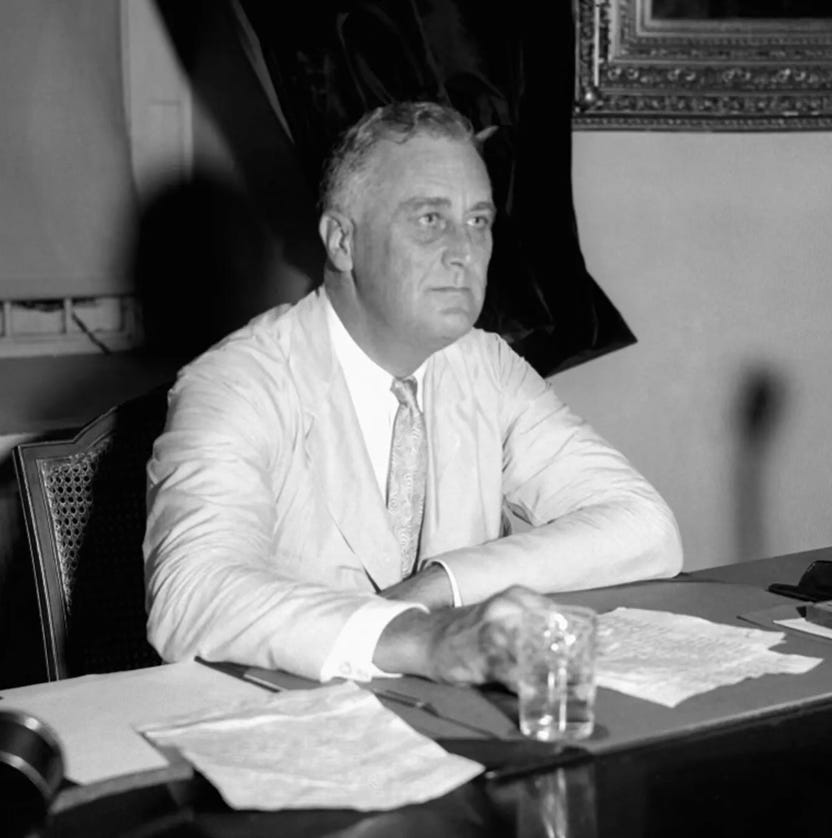
— DJT’s slouches are entirely self-centered, self-interested, self-aggrandizing. The Times also botches the use of “President.” Roosevelt was the real thing; Trump is just an autocratic punk.
Nor is there a discrete, circumstantial parallel in Roosevelt’s attempted ousting of an independent agency’s member and Trump’s striving to boot one — their motivations, starkly dissimilar, as unlike one another as the two principals’ proper, above-noted designations.
The removal maneuverings’ backstory again goes to FDR’s inner grace, goodwill and compassion dispersed widely and DJT’s concentrated core of caprice, malice and determined domination of every last American.
Roosevelt grounded his 1933 presidency on alleviating the nation’s desperate firmament of mass unemployment, immense poverty and unprecedented business bankruptcies — all of it grinding away in a landscape of despair turned ugly. The other’s second-shot crime organization inherited a macro-rebounded scene portrayed as “the envy of the world” by The Economist — promptly targeted by Trump for demolition.
FDR’s unparalleled efforts in mitigating the decade’s aggrieved, heartsick joblessness of 13 million Americans — a full fourth of available workers — and devastation of the commercial and agricultural sectors ran into the violence of a throwback mind, that of FTC member William Humphrey.
At President Roosevelt he spit fire. FTC-appointed in 1925 by the always carefree Coolidge and reappointed by his largely misery-indifferent successor, Humphrey opposed his as well as other agencies’ scrutiny of what FDR later called the “new dynasties” of “economic royalists.” Coming from the 19th-century-holdover commissioner, that much was pretty much standard Republican fare.
But Humphrey discharged disproportionately blazing assaults on Roosevelt that are best described as stupendous ironies of our times. He accused the president of seeking his resignation “for purely political reasons” and of savoring only contempt for the operational independence of federal agencies.
Commissioner William Humphrey’s ultimate coup de grâce (or so he thought) thrust on beastly chief executive Franklin Roosevelt: Horrifying it is, he protested, that government officials should serve under the unmerciful “caprice“ of some guy “who happens, by the chance of politics, to occupy the White House.”
I needn’t update the matter of some other guy’s political capriciousness. I’ll re-note only that FDR’s maneuvering was neither political nor capricious; it was spot-on aimed at the betterment of Americans’ welfare, nothing less, nothing more.
Though Humphrey died in 1934, his legal argument went on. In 1935 the Supreme Court ruled unanimously in support of the deceased commissioner’s case as the justices also annihilated huge structural components of President Roosevelt’s humanitarian New Deal.
Tomorrow the Court will hear arguments in Trump’s aptly named case of Slaughter. And in early 2026 the majority justices will announce their support of the autocratic punk’s escalation of reckless, malicious power for his sole benefit.
***